WJEC物理 简谐运动 引力场 电势 磁场 感应
WJEC 的 A2 物理把振动放在 Unit 3 Oscillations and Nuclei,把场放在 Unit 4 Fields and Options,两章在考试里常常连着出题。这篇按 12 个具体知识点把公式、图像与失分点串一遍。
This walkthrough connects the vibrations content of Unit 3 with the field content of Unit 4, following the WJEC specification rather than a generic textbook order.
加速度与位移成正比是简谐运动的判据
WJEC 物理的振动一章从加速度讲起,不从位移讲起。判断一个运动是不是简谐运动,只看加速度与位移是否成正比、是否始终指向平衡位置,写成 a = -ω²x。负号承担了全部含义:位移向右时加速度向左,位移为零时加速度也为零。弹簧振子挂着砝码上下动,砝码经过中点时速度最大、加速度为零。很多学生以为速度为零才是平衡状态,把这条判据写反。阅卷时能看到大量把平衡位置写成速度为零的答案,这是最典型的概念混淆。摆球在最低点同理,回复力为零而速度最大。把这一行写对,后面的周期、能量、图像才有落点。
The vibrations chapter begins with acceleration rather than displacement, and the test for simple harmonic motion is a proportionality statement: acceleration is proportional to displacement and always directed back towards equilibrium, so a = -ω²x. The minus sign carries the whole physics, because a displacement to the right pairs with an acceleration to the left and both vanish at the centre; in a spring oscillator the mass travels fastest as it passes that centre. Examiners see candidates calling the equilibrium position the point of zero velocity, which reverses the relationship. Once the criterion is written correctly, period, energy and graphs follow from it.
周期频率与角频率的换算关系
周期 T 是一次完整振动所用的时间,频率 f 是每秒完成的振动次数,两者互为倒数。角频率 ω 把每秒的振动次数换算成每秒转过的弧度,ω = 2πf = 2π/T。做题时先把 T 从图像或者题干里读出来,再换成 ω,不要一上来就往公式里代数字。摆长 0.98 m、g 取 9.8 m/s² 的单摆,T = 2π√(0.98/9.8) = 2π × 0.316 ≈ 1.99 s,ω ≈ 3.16 rad/s。单位要写在每个结果后面,T 用秒,f 用赫兹,ω 用 rad/s。很多学生以为 ω 就是频率的另一种写法,把 50 Hz 的运动写成 ω = 50,数值差了 2π 倍。这个错误在共振与相位题里会连带后面全错。
Period, frequency and angular frequency describe one motion in three currencies, with frequency the reciprocal of period and angular frequency converting cycles per second into radians per second. Read the period off the graph or the question stem first, then convert; substituting raw numbers too early is where arithmetic slips enter, and a pendulum of 0.98 m with g at 9.8 m/s² gives T ≈ 1.99 s and ω ≈ 3.16 rad/s. Quoting 50 Hz as ω = 50 is off by a factor of 2π, an error that contaminates every resonance and phase calculation downstream. Keep the units attached to each result, since seconds, hertz and radians per second are not interchangeable.
弹簧振子与单摆的周期公式
弹簧振子的周期只由质量和劲度系数决定,T = 2π√(m/k),与振幅无关。单摆的周期只由摆长和当地重力加速度决定,T = 2π√(l/g),与小球质量无关。两条公式的实验价值在于可以反过来测 k 与 g:作 T² 对 m 的图,斜率是 4π²/k;作 T² 对 l 的图,斜率是 4π²/g。用斜率求 g 比逐点代入更稳,因为斜率的相对误差只来自读数的分散。常见的错误是把振幅也当成变量写进结论,其实大振幅下周期略微变长,WJEC 考纲只在简谐近似成立的范围内使用这两条公式。摆长要量到球心,只量到悬点下方那段线会系统性偏短。
For a spring oscillator the period depends only on mass and stiffness, and for a simple pendulum only on length and the local value of g, which is what turns both systems into measuring instruments. Plotting T² against m gives a gradient of 4π²/k, and plotting it against l gives 4π²/g; the gradient route beats point-by-point substitution whenever readings scatter. Amplitude is not a variable inside either formula within the small-angle, small-extension approximation used by the specification, because at larger amplitudes the period lengthens slightly and the approximation starts to bite. Measure pendulum length to the centre of the bob, since stopping at the lower end of the string loses about a centimetre every time.
位移速度加速度三条曲线的相位差
位移、速度、加速度三条曲线画在同一张图上,彼此相差四分之一周期。位移取余弦时,速度是负正弦,加速度是负余弦。位移最大处速度为零、加速度最大;位移为零处速度最大、加速度为零。求某时刻的速度可以用 v = ±ω√(A² - x²),符号由运动方向决定,这一步经常被漏掉。相位差 π/2 的说法要能落到图上:速度曲线比位移曲线提前四分之一周期到达峰值。很多学生以为三条曲线形状一样就是相位一样,实际上它们的起点都不同。画图时标出平衡位置和两个端点,比背三条代数式更可靠。
Displacement, velocity and acceleration share one graph with a quarter of a cycle between neighbours. With a cosine for displacement, velocity follows a negative sine and acceleration a negative cosine; the extremes are where velocity vanishes and acceleration peaks, and the centre reverses that pattern. Speed at a given displacement comes from v = ±ω√(A² - x²), with the sign justified from the direction of travel rather than assumed. The three curves look similar in shape but start at different points, so marking equilibrium and the two turning points on the axes is more reliable than memorising three algebraic forms.
简谐运动中动能与势能的互换
简谐运动里动能和势能来回交换,总能量保持不变,前提是阻尼可以忽略。总能量 E = ½mω²A²,动能最大在平衡位置,势能最大在两个端点。位移为 x 时的动能是 ½mω²(A² - x²),这个式子把速度与位移的关系直接变成能量关系,省掉先求速度再平方的步骤。振幅加倍,总能量变成四倍;质量加倍而振幅不变,总能量也加倍。常见的错误是拿最大动能减势能时,把 ½mω² 里的 ω 写成了频率 f,量纲一查就会差 (2π)²。能量图的横轴是位移、纵轴是能量,两条抛物线的和是一条水平线。这张图在解释振幅与总能量的关系时比公式直观。
Kinetic and potential energy trade places while their sum stays constant, provided damping is negligible. Total energy goes as ½mω²A², so doubling the amplitude quadruples the stored energy, and kinetic energy at displacement x is ½mω²(A² - x²), which removes the need to find speed first. Plotting both energies against displacement gives two parabolas whose sum is a horizontal line, a picture worth keeping for graph-reading questions. The recurring slip is substituting frequency for angular frequency in the prefactor, which throws the answer off by (2π)².
阻尼与共振曲线的读数
自由振动以固有频率进行,受迫振动的频率等于驱动频率,与固有频率无关,这一句常被写反。驱动频率接近固有频率时振幅达到最大,这就是共振。阻尼越大峰值越低,峰值位置略向低频偏移。轻阻尼下峰值高而窄,重阻尼下曲线平缓,过阻尼根本不振荡。
WJEC 的共振题常给一条振幅与频率的关系曲线,要求比较两种阻尼,读数看峰高与半高宽就够。桥、秋千、音叉是同一套逻辑:外界按某个频率推,系统按驱动频率动,能量在接近固有频率时最容易累积。很多学生以为阻尼会改变固有频率,其实变的是峰值高度与宽度。题目问共振的危害时,答案要落到振幅过大引起的形变,而不是泛泛地说不稳定。
A free oscillator rings at its natural frequency, whereas a forced one moves at the driving frequency regardless of where its natural frequency sits; reversing those two is the most common sentence-level error in this topic. Amplitude peaks as the drive approaches the natural frequency, with heavier damping flattening the peak and nudging it towards lower frequencies, and heavy damping removes the oscillation altogether, which is why door closers do not swing. Exam questions usually hand over an amplitude-frequency curve and ask for a comparison of two damping levels, so read peak height and width instead of re-deriving the theory. Bridges, swings and tuning forks obey the same logic, and energy accumulates fastest when the drive matches the natural frequency.
引力场强度与万有引力定律
牛顿万有引力定律给出 F = GMm/r²,两点质量之间的力沿连线作用。引力场强度定义为单位质量受到的引力,g = F/m = GM/r²。地球表面取 g = 9.81 N/kg,离地越高 g 越小。卫星轨道上的 g 并不是零,卫星只是在做自由落体。径向场线指向球心,密度表示强度;近地面小范围内的匀强场画成等间距的平行线。两个质量产生的场叠加时按矢量相加,方向相反就相减。常见的错误是把 g 与 G 混用,G 是 6.67 x 10^-11 N m^2 kg^-2 的普适常数,g 是某点的场强数值。作 g 对 r 的图,星球表面以内按 r 正比上升,以外按 1/r² 下降。
Newton's law of gravitation gives a force of GMm/r² between point masses, so field strength follows as force per unit mass, g = GM/r². At the Earth's surface that is about 9.81 N/kg and it falls with altitude rather than vanishing, because a satellite is in free fall rather than in zero gravity. Radial field lines point at the centre of the mass and crowd where the field is strong, while a uniform field near the ground is drawn as evenly spaced parallel lines. Keep G, the universal constant at 6.67 x 10^-11 N m^2 kg^-2, separate from g, the local field strength, since conflating them is a marking-scheme error rather than a slip.
引力势与引力势能的负号
引力势定义为单位质量从无穷远移到该点过程中外力所做的功,V = -GM/r,负号表示引力场是束缚场。引力势能 U = -GMm/r,与势的关系是 U = mV。势是标量,两个质量的总势直接做代数相加,比矢量场省事。逃逸速度由 ½mv² = GMm/R 得到 v = √(2GM/R),地球约 11.2 km/s,与抛射方向无关。等势面与场线垂直,在地球重力场里就是水平面。常见的错误是漏掉负号,或者在求势差时把 V 当成矢量做分量分解。WJEC 官网的公式表把 V = -GM/r 与 U = -GMm/r 并列给出,两个量不要混。
Gravitational potential is the work done per unit mass in bringing a mass from infinity, which is why it carries a minus sign: V = -GM/r. Potential energy is U = -GMm/r, related by U = mV, and because potential is a scalar, contributions from two masses add algebraically instead of as vectors. Escape speed comes from ½mv² = GMm/R as v = √(2GM/R), about 11.2 km/s for the Earth and independent of launch direction. Equipotentials meet field lines at right angles, which on the Earth's surface means a horizontal plane; dropping the minus sign or resolving potential as a vector are the two errors that cost marks here.
点电荷电场与电势的符号
库仑定律 F = Q₁Q₂/(4πε₀r²),点电荷的场强 E = Q/(4πε₀r²),方向由电荷正负决定。电势 V = Q/(4πε₀r),正电荷周围电势为正,负电荷周围为负,无穷远处取零。电场线与等势面垂直,电势沿场线下降最快,沿等势面移动不做功。与引力场对照着记最省力:质量总是互相吸引,引力势恒为负;电荷有正有负,电势可正可负。匀强电场里 E = V/d,d 要沿场线方向量,斜着量会把 d 算大。阅卷时常见把 E 与 V 的公式写反的答案,量纲一看就露。电势能 U = QV 与引力势能的形式一样,只是符号规则不同。
Coulomb's law gives F = Q₁Q₂/(4πε₀r²), and the field of a point charge is E = Q/(4πε₀r²) with the direction set by the sign of the charge. Potential follows as V = Q/(4πε₀r), positive around a positive charge and negative around a negative one, with zero taken at infinity; field lines cross equipotentials at right angles and no work is done moving along one. Comparing with gravity helps: mass only attracts, so gravitational potential is always negative, whereas charge comes in two signs and potential can take either. In a uniform field E = V/d, with d measured along the field lines, and swapping the E and V formulae is the error a dimensional check exposes immediately.
匀强电场中带电粒子的偏转
两块平行板之间的电场是匀强的,E = V/d,粒子受力 F = QE,加速度 a = QE/m。电子进入平行板后做抛体式运动,沿板方向匀速,垂直板方向匀加速。横向位移 y = ½at²,其中 t = L/v 由板长和初速决定。加速段用能量守恒 eV = ½mv²,偏转段用运动学,两段不要混用。示波管和喷墨打印头都是这个模型。常见的错误是拿整块板长当垂直位移,或者忘记把 eV 换成焦耳,1 eV = 1.6 x 10^-19 J。作轨迹图时把初速方向画成直线,偏转方向与电场力方向一致,电子受到的力与场方向相反。
Between two parallel plates the field is uniform with E = V/d, so a particle feels F = QE and accelerates at QE/m. An electron entering sideways behaves like a projectile, travelling at constant speed along the plates while accelerating across them, with y = ½at² and t = L/v set by plate length and initial speed. Use energy conservation eV = ½mv² in the accelerating section and kinematics in the deflecting section, because mixing the two is the usual source of wrong answers, and remember that 1 eV = 1.6 x 10^-19 J. Oscilloscope tubes and inkjet heads run on exactly this model, with the force on an electron pointing against the field.
磁场力与带电粒子的圆周运动
磁场对电流的力是 F = BIL sinθ,导线与磁场垂直时取最大值,平行时为零。对单个运动电荷有 F = BQv sinθ,方向用左手定则判断,正电荷与负电荷方向相反。电荷垂直进入匀强磁场后做匀速圆周运动,半径 r = mv/(BQ),周期 T = 2πm/(BQ) 与速度无关,这是回旋加速器能够工作的原因。磁场不做功,速率不变,只改变方向。常见的错误是把 r = mv/(BQ) 当成通用式却忘了 B 与 v 垂直这个前提。WJEC 的实验部分用电流天平或霍尔探头测磁通密度,读数要取多组求平均再算不确定度。
The force on a current in a magnetic field is F = BIL sinθ, largest when the wire is perpendicular to the field and zero when it is parallel. A single moving charge feels F = BQv sinθ, directed by Fleming's left-hand rule with the sign of the charge flipping the result. A charge entering perpendicular to a uniform field moves in a circle of radius r = mv/(BQ) and period T = 2πm/(BQ) independent of speed, which is how a cyclotron keeps particles in step. Magnetic forces do no work, so the speed stays fixed while only the direction turns, and measurements of flux density with a current balance or Hall probe need several readings averaged before an uncertainty is quoted.
法拉第定律与楞次定律的判断顺序
法拉第定律写成 ε = -dΦ/dt,负号就是楞次定律:感应电流产生的磁场总要阻碍磁通量的变化。导体棒在磁场中以速度 v 切割磁感线时 ε = BLv,这是最常考的形式。线圈有 N 匝时 ε = -N dΦ/dt,面积不变就换成 B 的变化率,B 不变就换成面积的变化率。判断方向按三步走:先看原磁通是增还是减,再定感应磁场的方向,最后用右手螺旋定则落到电流方向。常见的错误是只看磁通的大小不看变化率,磁通很大但不变时感应电动势为零。实验中测感应电动势要接数据采集器,峰值出现在磁铁穿过线圈中点的瞬间。
Faraday's law reads ε = -dΦ/dt, and the minus sign is Lenz's law: the induced current creates a field that opposes the change in flux. A rod cutting field lines at speed v gives ε = BLv, the version that appears most often, while an N-turn coil uses ε = -N dΦ/dt with either B or the area varying but not both. Decide direction in three moves, noting whether flux is rising or falling, fixing the direction of the induced field, then applying the right-hand grip rule to the current. Flux that is large but unchanging produces no emf at all, and in the experiment the peak reading arrives as the magnet passes the middle of the coil.
把振动与场放在一起复习的好处是两套语言可以互相翻译:位移、速度、加速度对应势、场强、能量,场的叠加与势的代数相加对应矢量与标量。WJEC 的 Unit 3 与 Unit 4 都是 2 小时以上的笔试,公式表会给,但符号含义与单位要自己写清。
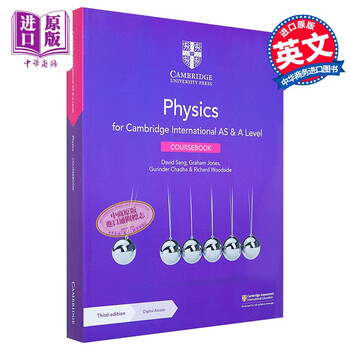
Cambridge International AS ALevel Physics Coursebook 正版剑桥国际AS ALevel考试物理教材带线上账号 英文原版¥557.0📱 去京东购买京东精选


需要一对一辅导?Need One-on-One Tutoring?
A-Level / GCSE / IB / KS2-KS3 全科辅导
16621398022 同微信
Visit aleveler.com
或截图后用「扫一扫 → 相册」选择本图