IB物理 引力场 电场 磁场 电势 电磁感应
IB 物理 2025 版考纲(first assessment 2025)把场放在 Theme D:D.1 引力场、D.2 电场与磁场、D.3 电磁场中的运动、D.4 电磁感应(HL 专属)。这一主题的题目很少只问一个公式,多数是把场的图像、受力方向和能量变化串在一起问,一步符号错了整题掉分。按 IB 官方科目说明(subject brief),Paper 1 占 36%、Paper 2 占 44%、科学探究占 20%,场这部分最常见于 Paper 2 的长答。下面按 IBO 考纲顺序拆成十二个小节,每节给定义、给公式、给一个能照着算的例子,最后给一份按依赖关系排的复习顺序。
In the 2025 IB Physics guide, fields form Theme D, covering gravitational fields, electric and magnetic fields, motion in electromagnetic fields, and induction for HL. The assessment split is 36 per cent for Paper 1, 44 per cent for Paper 2 and 20 per cent for the scientific investigation, and field questions cluster in the longer Paper 2 answers. Each section below gives one definition, one formula and one worked number, so the arithmetic can be checked rather than only read.
一、场线到底怎么读
场本身看不见,考卷上只能靠场线判断强弱和方向。规则不多:线越密场越强,线上某点的切线方向就是该点的场方向,线从正电荷出发指向负电荷,从无穷远指向质量。点电荷周围是辐射状,平行板之间是等距平行线,这两种画法在 Paper 1B 的读图题里出现频率很高。很多学生以为场线就是粒子的运动轨迹,其实两者不是一回事,静止释放的正电荷才沿着场线走,带电粒子一旦有初速度,在匀强电场里走抛物线,在匀强磁场里走圆弧。画图题里等势面与场线始终垂直,这一点常被忽略,也常被单独问。
Field lines are a map of a field, not a record of where a particle went. Line density shows strength, the tangent gives the push on a small positive test charge, and equipotential surfaces always cut the local line at right angles. Confusing the map with the path costs marks quickly, because a charge with initial velocity curves into a parabola in a uniform electric field and into an arc in a uniform magnetic field, and neither curve follows a field line.
二、引力场强度 g 与 GM 除以 r 平方
引力场强度定义为单位质量受到的引力,g = F/m = GM/r^2,单位是 N/kg。把地球质量 5.97×10^24 kg 和半径 6.37×10^6 m 代入数据手册的 G = 6.67×10^-11 N m^2 kg^-2,得到约 9.81 N/kg,与自由落体加速度数值相同,因为 m/s^2 和 N/kg 本就是同一个量纲。火星质量约为地球的 0.107 倍、半径约为 0.532 倍,按平方反比算下来表面 g 约 3.7 N/kg,这类似是而非的比例题几乎每次都出。高度增加时 g 按 r 的平方衰减,400 km 的空间站轨道上只剩约 8.7 N/kg。常见的错误是把 g 当常数直接代进轨道题。
Gravitational field strength is force per unit mass, so g equals GM over r squared and is measured in newtons per kilogram. Working with the booklet value of G and Earth's mass and radius returns 9.81, which explains why field strength and free-fall acceleration share a number. Mars, with about 0.107 of Earth's mass and 0.532 of its radius, gives roughly 3.7 at the surface, so ratio questions should be answered with the square of the radius ratio rather than with a memorised constant.
三、圆轨道速度与开普勒第三定律
圆轨道上引力全部用来提供向心力,GMm/r^2 = mv^2/r,解出 v = sqrt(GM/r),再用 T = 2πr/v 化简得到 T^2 正比于 r^3,这就是开普勒第三定律。近地轨道 400 km 处速度约 7.7 km/s,绕一圈约 92 分钟,这也是低轨卫星寿命短、需要不断抬轨的原因。地球同步卫星的周期取 8.64×10^4 s,代入可得轨道半径约 4.22×10^7 m,减去地球半径,离地约 3.6×10^4 km。很多学生以为同步卫星可以放在任意高度,其实半径由周期唯一确定,倾角还必须接近零才能一直停在赤道某点上方。
Circular orbits work because gravity supplies the whole centripetal requirement, which gives a speed of root GM over r and, after substituting the period, the third law in the form that the period squared scales with the radius cubed. Low Earth orbit at 400 km therefore runs near 7.7 kilometres per second with a period of about 92 minutes, while a geostationary satellite needs 86,400 seconds and is pushed out to roughly 42,000 km from the centre. Height is an output, never an input, when the period is fixed.
四、引力势、引力势能与逃逸速度
引力势定义为 Vg = -GM/r,零点取在无穷远,所以越靠近质量势越负;引力势能 Ep = m Vg = -GMm/r。场强与势的关系是 g = -ΔV/Δr,负号说明场指向势降低的方向,从 V-r 图像的斜率就能读出 g,而 V-r 曲线始终在横轴下方并随 r 增大趋近于零,画成穿过横轴是常见错法。逃逸速度由能量守恒得到 v = sqrt(2GM/r),地球约 1.12×10^4 m/s,也就是 11.2 km/s,月球只需 2.4 km/s。常见的错误是把势当矢量去做合成,势是标量,多个源就代数相加。
Gravitational potential is minus GM over r with zero fixed at infinity, so it grows more negative near a mass and never crosses above the axis. Because field strength is the negative gradient of potential, a slope read off a potential graph is already a field strength, and the minus sign only records that the field points downhill. Escape speed follows from energy conservation, giving about 11.2 kilometres per second for Earth and far less for the Moon, and because potential is scalar, several sources are summed algebraically.
五、库仑定律与电场强度
库仑定律写作 F = k q1 q2 / r^2,数据手册给 k = 8.99×10^9 N m^2 C^-2。两个点电荷相距 0.30 m,电量分别为 2.0 微库与 -3.0 微库时,F = 8.99×10^9 乘 6.0×10^-12 再除以 0.090,约 0.60 N,负号只表示方向相反即相互吸引。距离减半力变四倍、电量翻倍力也翻倍,这类倍数题比数值题更常考,先做比值再代数能省时间。电场强度定义为单位正电荷受到的力,E = F/q = kQ/r^2,方向取正电荷受力方向。错得最多的是以为 E 和试探电荷有关,其实 E 只由源电荷和距离决定。
Coulomb's law gives the force between two point charges as k times the product of the charges divided by the square of the separation. Thirty centimetres between plus two and minus three microcoulombs produces about 0.60 newtons, and the opposite signs mean attraction rather than repulsion. Field strength is force per unit positive charge, so it is fixed by the source and the distance, and halving the separation multiplies the force by four whatever test charge is used to probe it.
六、平行板间的匀强电场
两块平行金属板加上电压后,板间是匀强电场,E = V/d。120 V 加在相距 2.0 cm 的两板上,E = 6.0×10^3 V/m。电子受力 F = eE = 9.6×10^-16 N,加速度约为 1.05×10^15 m/s^2,方向指向正极板,因为电子带负电。垂直进入的粒子沿场方向匀加速、垂直方向匀速,飞行时间 t = L/v 由板长和初速决定,横向位移 y = 0.5 a t^2,合起来是抛物线,和抛体运动用同一套分解。常见的错误是把 E = V/d 套到点电荷周围,那条公式只在匀强场成立。
Parallel plates held at a potential difference create a uniform field whose strength is the voltage divided by the gap, so 120 volts across two centimetres gives six thousand volts per metre. An electron there accelerates at about ten to the fifteen metres per second squared towards the positive plate, and because the transverse acceleration is constant while the longitudinal speed is not, the path is a parabola with flight time set by plate length over entry speed. Substituting the plate formula for a point charge field is the standard slip.
七、电势、电势能与等势面
点电荷周围的电势 V = kQ/r 带符号,正电荷附近为正,负电荷附近为负;电势能 Ep = qV,把电荷从一点移到另一点做功 W = qΔV,与路径无关。匀强电场的等势面是一组平行于极板的平面,点电荷周围是一组同心球面,两者都与场线垂直;沿等势面移动电荷不做功,相邻等势面越密说明场越强。数据手册给 e = 1.60×10^-19 C,电子经过 100 V 加速后动能是 1.60×10^-17 J,折合约 100 eV。很多学生以为电势和电势能是一回事,差的就是那个 q。
Potential around a point charge is kQ over the distance and keeps the sign of the source, while potential energy is charge times potential. Moving a charge between two points therefore costs charge times the potential difference and is independent of the route, which is why sliding along an equipotential is free. The electronvolt conversion is worth memorising, since an electron through one hundred volts gains one hundred electronvolts and nothing more needs calculating.
八、磁场、磁通密度与右手定则
磁通密度 B 的单位是特斯拉 T,用来描述磁场强弱和方向。长直导线的场线是围绕导线的同心圆,方向用右手螺旋:拇指指电流方向,四指绕出的方向就是场方向;螺线管内部场线近似平行且均匀,外部像条形磁铁。地磁场只有 5×10^-5 T 量级,医院核磁共振能到 1.5 T 以上,知道这两个数量级,判断答案是否离谱会快很多。磁场方向规定为小磁针 N 极受力方向,在磁体内部由 S 极指向 N 极。B 是矢量,写答案时方向单独给分,漏掉方向通常丢一半分。
Magnetic flux density, measured in tesla, fixes both how strong a field is and which way it points. Around a straight wire the lines form concentric circles set by the right-hand grip rule, while inside a solenoid they run parallel and evenly spaced, which is why a solenoid behaves like a bar magnet from outside. Knowing that the Earth's field is around fifty microtesla and a scanner magnet exceeds one tesla makes order-of-magnitude checks almost instant.
九、磁场力 BIL 与 qvB
通电导线在磁场中受力 F = BIL sinθ,θ 取电流与 B 的夹角,方向用左手定则,食指指 B、中指指电流、拇指指受力;电流与磁场平行时 sinθ 为零,导线不受力,这一点常被漏答。运动电荷受力 F = qvB sinθ,力始终垂直于速度,所以磁场力不做功、不改变速率,只改变方向,垂直进入匀强磁场的粒子因此走圆周,半径 r = mv/(|q|B)。质子以 2.0×10^6 m/s 垂直进入 0.50 T 的磁场,半径约 4.2 cm。常见的错误是给磁场力求功,那一步必然是零。
A wire carrying current in a field feels BIL sine theta, and the force vanishes whenever the current runs parallel to the field. A moving charge feels qvB sine theta, and since this force stays perpendicular to the velocity it redirects the particle without changing its speed. Equating it to the centripetal requirement gives a radius of mass times speed over charge times flux density, about four centimetres for a proton near two million metres per second in half a tesla, and no work is done at any point along that arc.
十、速度选择器与回旋加速器
速度选择器让电场力与磁场力等大反向,qE = qvB,只有 v = E/B 的粒子能直线通过。取 E = 3.0×10^4 V/m、B = 0.15 T,筛出的速度是 2.0×10^5 m/s,与电荷量和质量都无关,这正是它能筛速度的原因。回旋加速器里粒子的回旋频率 f = qB/(2πm),1.0 T 的磁场中质子约 15 MHz,与速率无关,所以交变电压的频率固定不变。半径上限 R 决定了最高速率 v = qBR/m,很多学生以为加大电压就能无限提速,其实换更快的粒子得换更大半径或更强磁场。
A velocity selector balances electric and magnetic forces so that only particles with speed equal to field strength over flux density travel straight, regardless of charge or mass. A cyclotron uses the fact that circulation frequency depends on flux density and mass alone, which is why the driving voltage holds a fixed frequency while the orbit expands. The ceiling on speed comes from the machine radius, so raising the voltage alone never lifts the final energy.
十一、电磁感应:磁通量、法拉第与楞次(HL)
磁通量写作 Φ = BA cosθ,θ 取 B 与线圈法线的夹角,这一处最容易错,很多人拿成与线圈平面的夹角。法拉第定律 ε = -N ΔΦ/Δt,负号就是楞次定律:感应电流产生的磁场总要阻碍原磁通量的变化,答题时先说原磁通方向、再说它变大还是变小、最后说感应磁场方向,三步齐全才给满分。直导体棒垂直切割时 ε = BvL,长度 0.20 m 的棒以 3.0 m/s 在 0.50 T 中运动,电动势为 0.30 V。线圈匀速转动时电动势按正弦变化,磁通为零的瞬间电动势反而最大。2025 版考纲把感应整体列为 HL 专属内容。
Flux through a coil is flux density times area times the cosine of the angle between the field and the normal, and the normal is what candidates most often misread as the plane of the coil. Faraday's law turns a changing flux linkage into an emf, and the negative sign carries Lenz's rule that the induced current opposes the change responsible for it, so a full answer states the original flux, its change, then the induced field. A rod sweeping across a field gives field times speed times length, and in a rotating coil the emf peaks exactly where the flux passes through zero.
十二、按依赖关系排的复习顺序
复习顺序按依赖关系排更省时间:先 D.1 的 g、Vg 和轨道,再 D.2 的库仑定律与匀强电场,然后 D.3 的带电粒子运动,最后 D.4 感应。做题前先判断这道题要矢量还是标量,矢量题写方向,标量题看符号,数据手册的常数统一换成 SI 再代入。Paper 1B 会给一段实验数据,图像斜率往往就是所求量,比如 V 与 r 的图斜率给出 g,Φ 与 t 的图斜率给出电动势。每周留一次四十分钟的限时整卷,比反复看笔记更能暴露真实问题,错题按上面十一节的编号归类,复习第二轮时直接回看对应小节。
The efficient order follows dependencies instead of the textbook sequence: field strength and potential with orbits first, then Coulomb's law and uniform fields, then charged particles in flight, and induction last. Before calculating, decide whether the answer is a vector that needs a direction or a scalar that carries a sign, and convert everything into SI units before touching the booklet constants. Data-based questions usually hide the answer in a gradient, so a potential against distance graph yields a field strength and a flux against time graph yields an emf.
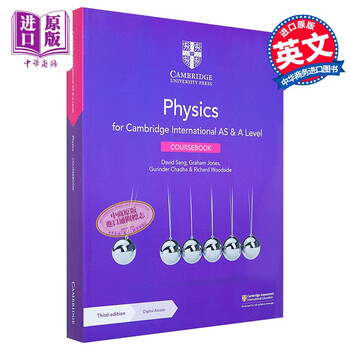
Cambridge International AS ALevel Physics Coursebook 正版剑桥国际AS ALevel考试物理教材带线上账号 英文原版¥557.0📱 去京东购买京东精选


需要一对一辅导?Need One-on-One Tutoring?
IB / A-Level / GCSE / KS2-KS3 全科在线辅导
16621398022 同微信
IB 物理真题与讲义 aleveler.com

或截图后用「扫一扫 → 相册」选择本图