AQA物理 光电效应 能级 德布罗意波 夸克
Particles and Radiation 是 AQA A-Level Physics 7408 里 3.2 节的内容,题目形式很固定:给几个数字,让你算能量差、频率、波长,再问一句物理意义。真正拉开差距的地方不在模型本身,而在单位换算、公式顺序,和对实验证据的表述。下面按考试里出现的顺序把六个知识块串一遍,每个公式都配上用法、一个算例和常见的丢分点。
The Particles and Radiation section of the AQA A-Level Physics 7408 specification looks narrow on paper, but it carries a large share of the short calculation marks. Most questions hand you two or three numbers, ask for an energy gap, a frequency or a wavelength, and then add a line about physical meaning. This article walks through the six blocks in the order they appear on a paper, with the arithmetic, one worked example each, and the usual places where marks disappear.
光子能量与逸出功
光子说把光看成一份份能量,每份 E = hf,h 取 6.63 x 10^-34 J s。金属表面的电子要逃出来,先得付一笔逸出功 phi,题目里常给成 eV。只有 hf 大于 phi,电子才能逸出;两者刚好相等时的频率叫截止频率 f0,f0 = phi / h。很多学生以为把光调亮就能让光子能量变大,实际上光强只增加单位时间打上去的光子数,单个光子的能量只由频率决定。用红光不管照多久都打不出电子,换成频率更高的紫光,哪怕很弱也能立刻有电子逸出。
算例用钠,phi = 2.28 eV。先把逸出功换成焦耳:2.28 x 1.60 x 10^-19 = 3.65 x 10^-19 J。截止频率 f0 = 3.65 x 10^-19 / 6.63 x 10^-34,约 5.5 x 10^14 Hz。对应的截止波长 lambda0 = c / f0 = 3.00 x 10^8 / 5.5 x 10^14,约 5.5 x 10^-7 m,也就是 550 nm 附近,落在绿光波段。这条线说明钠对黄光、红光不响应,对绿光以上的频率才开始发射。答题时把 eV 换算写在第一行,后面每一步才有意义。
Light arrives in packets, and each packet carries E = hf with h = 6.63 x 10^-34 J s. An electron at the surface of a metal has to pay a fixed price, the work function phi, before it can leave, and that price is usually quoted in electronvolts. If hf is smaller than phi nothing escapes, no matter how long the lamp stays on. Raise the frequency until hf just equals phi and you have reached the threshold frequency f0 = phi / h. A brighter lamp of the same colour changes nothing about the energy of a single photon; it only delivers more photons per second. This is why a strong red lamp produces no emission while a dim ultraviolet lamp produces it at once. Sodium makes a useful test case, with a work function of 2.28 eV. Convert that to 3.65 x 10^-19 J, divide by h, and the threshold frequency comes out near 5.5 x 10^14 Hz, a wavelength of about 550 nm. Sodium therefore ignores yellow and red light and only responds from the green part of the spectrum upwards.
遏止电压与最大动能
实验里把反向电压调到刚好让光电流归零,这个读数就是遏止电压 Vs。跑得最快的那批电子恰好被这个电压止住,所以最大动能 KEmax = eVs,也等于 hf - phi。AQA 卷面经常把 eV 和 J 混着给,先把单位统一再代公式。常见的错误是把 KEmax 当作所有电子的动能:其实只有最表层、逃出路上没有损失的那些电子拿满 hf - phi,深处的电子要克服更多束缚,出来时动能更小。图像题里 KEmax 对 f 作图是一条直线,斜率是普朗克常量 h,横轴截距是 f0,纵轴截距是 -phi。
接着上面的钠:入射光波长 400 nm,光子能量 E = hc / lambda = 6.63 x 10^-34 x 3.00 x 10^8 / 4.00 x 10^-7,得 4.97 x 10^-19 J,换成 eV 是 3.11 eV。减去 2.28 eV 的逸出功,最大动能 0.83 eV,也就是 1.33 x 10^-19 J。遏止电压直接读 0.83 V。如果同一盏灯换成 500 nm 的光,单光子能量降到 2.48 eV,还是大于 2.28 eV,光电子照样出来,只是最大动能只剩 0.20 eV,遏止电压不到 0.2 V。这组数字常被拿来考「频率变一点,动能变多少」。
Apply a reverse potential until the photocurrent falls to zero and the voltmeter reads the stopping potential Vs. The fastest electrons are stopped by exactly that potential, so their kinetic energy is eVs and the photoelectric equation gives eVs = hf - phi. Marks here are lost on units more often than on physics: papers happily mix eV for the work function with joules for the photon energy, and the two have to be brought together before substitution. A second trap is treating KEmax as the kinetic energy of every emitted electron. Only electrons at the very surface, losing nothing on the way out, collect the full hf - phi, while electrons from deeper layers escape with less. Plotted against frequency, KEmax is a straight line whose gradient is h, whose horizontal intercept is f0 and whose vertical intercept is -phi. With the same sodium surface and 400 nm light, the photon energy works out at 4.97 x 10^-19 J, or 3.11 eV, leaving 0.83 eV of kinetic energy and a stopping potential of 0.83 V. Switch to 500 nm and the maximum kinetic energy drops to 0.20 eV, so the photocurrent still appears but is stopped by less than 0.2 V.
能级跃迁与线状光谱
原子里的电子只能待在离散的能级上。受激到高能级后回到低能级,能量差以一个光子的形式放出,hf = E2 - E1。因为能级是固定的一组值,放出的频率也是一组固定值,线状光谱就这么来的。用电子碰撞激发时,入射电子的动能只要不小于能级差就能激发,多余的部分留在散射电子身上。电离是另一件事,电子彻底离开原子,从基态算起的电离能就是 0 与 E1 之差。学生常把激发和电离混为一谈,写成电子跃迁到无穷远就丢分。计算题常从光谱线波长入手,先换算成米,再用 hc / lambda 得到能量差。
氢原子的能级是 -13.6 eV、-3.40 eV、-1.51 eV 这样一串负值,基态最深。电子从 n=2 掉回 n=1,能量差 10.2 eV,换成焦耳是 1.63 x 10^-18 J,频率 f = 1.63 x 10^-18 / 6.63 x 10^-34,约 2.46 x 10^15 Hz,波长 lambda = c / f 约 1.2 x 10^-7 m,属于紫外。四条可见谱线来自更高的能级往 n=2 跳,这也是为什么氢的可见光谱只有几条固定颜色。答这类题时先画能级图,把箭头画出来再代数,比直接背公式可靠。
Electrons in an atom sit on discrete levels rather than anywhere they like. An electron excited to a higher level drops back and emits the difference as one photon, hf = E2 - E1. Because the levels are fixed, the emitted frequencies form a fixed set, which is exactly what a line spectrum shows. Collisions can excite an atom too: the incoming electron only needs kinetic energy at least equal to the gap, and any surplus stays with the scattered electron. Ionisation is a different event, where the electron leaves the atom completely, so the ionisation energy from the ground state is the gap between E1 and zero. Blurring those two words costs a mark. Calculation questions usually start from a wavelength, so convert to metres first and then use hc / lambda to reach the energy gap. For hydrogen, the jump from n = 2 down to n = 1 releases 10.2 eV, a frequency near 2.46 x 10^15 Hz and a wavelength of roughly 1.2 x 10^-7 m in the ultraviolet. The visible hydrogen lines all come from higher levels falling to n = 2, which is why only a handful of colours ever appear.
德布罗意波长与电子衍射
德布罗意把波长给了物质:lambda = h / p,p 是动量。宏观物体动量太大,波长小到没法观测;电子加速后动量适中,波长落在 10^-10 m 量级,正好和晶体里的原子间距相当。电子衍射实验里,多晶薄膜打出同心圆环,这是波性的证据;单缝给出明暗条纹。考试常要求先用 eV 求动能,再由 p = sqrt(2mE) 得到动量,最后算波长。这一步最容易把 eV 数值直接当成动能代入,忘了乘 1.60 x 10^-19。波粒二象性的表述要落在证据上:干涉和衍射说明有波性,光电效应说明有粒子性,同一束电子在不同实验里表现不同。
算例:电子经 500 V 加速。动能 500 eV = 8.00 x 10^-17 J,电子质量取 9.11 x 10^-31 kg。p = sqrt(2 x 9.11 x 10^-31 x 8.00 x 10^-17),约 1.21 x 10^-23 kg m/s。lambda = 6.63 x 10^-34 / 1.21 x 10^-23,约 5.5 x 10^-11 m。这个长度和 X 射线同量级,所以电子能像 X 射线一样被晶体衍射。把电压提到 2000 V,动能翻四倍,动量翻两倍,波长减半,衍射环的半径随之变小,这一点常出现在解释题里。
De Broglie attached a wavelength to matter: lambda = h / p, where p is momentum. For a cricket ball the momentum is so large that the wavelength is unmeasurably small, but an electron accelerated through a few hundred volts lands at around 10^-10 m, comparable to the spacing between atoms in a crystal. That is why electron diffraction works: a thin polycrystalline film throws concentric rings onto a screen, while a single slit gives bright and dark fringes. The arithmetic runs in three steps, kinetic energy from eV, momentum from p = sqrt(2mE), wavelength from h / p, and the first step is where slips happen. Wave-particle duality is best stated as evidence rather than slogan: interference and diffraction require wave behaviour, the photoelectric effect requires particles. An electron through 500 V carries 8.00 x 10^-17 J, giving a momentum near 1.21 x 10^-23 kg m/s and a wavelength of 5.5 x 10^-11 m, the same order as soft X-rays. Quadruple the accelerating voltage and the wavelength halves, which is why the diffraction rings shrink.
夸克轻子与守恒定律
强子分两类:重子由三个夸克组成,介子由一个夸克和一个反夸克组成。质子是 uud,电荷 +1;中子 udd,电荷 0。夸克带分数电荷,+2/3 或 -1/3,加起来刚好对上,单独一个夸克从未在实验里出现。轻子不参与强相互作用,电子和中微子都属于轻子。粒子反应要同时守住电荷、重子数和轻子数:beta 负衰变里中子变成质子,放出一个电子和一个反中微子,重子数前后都是 1,轻子数前后都是 0。很多学生以为衰变放出的电子原本就存在核里,其实它是中子转变时产生的,核里并没有现成的电子。
守恒核对可以写成表格式的一行:n -> p + e- + 反中微子,左边电荷 0,右边 +1 -1 + 0,对得上;左边重子数 1,右边也是 1;左边轻子数 0,右边 0 + 1 - 1,还是 0。介子用 pi+ 试一次:pi+ 是 u 加反 d,电荷 +2/3 + 1/3 = +1,重子数 0,因为夸克数 2 不算重子。反过来,如果题目写出 p -> n + e+ + 中微子 这种式子,先查重子数:左边 1,右边 1,再看轻子数,左边 0,右边 -1 + 1,仍然守恒,但电荷和能量对不上,所以这个反应在自由空间里不会发生。
Hadrons fall into two groups. Baryons are built from three quarks, mesons from a quark and an antiquark. A proton is uud with charge +1, a neutron is udd with charge 0, and the fractional quark charges of +2/3 and -1/3 add up correctly in each case. No isolated quark has ever been observed. Leptons do not feel the strong interaction at all, which is why the electron and the neutrino sit in a separate family. Every reaction must conserve charge, baryon number and lepton number. In beta-minus decay a neutron turns into a proton and emits an electron and an antineutrino, with baryon number staying at 1 and lepton number at 0 on both sides. The electron is created during the decay, not stored in the nucleus beforehand, even though that is how the process is often pictured. Run the same checks on a positive pion, u plus anti-d, and the charges give +2/3 plus 1/3 for a total of +1 while the baryon number stays at zero, because two quarks do not make a baryon.
单位换算与答题顺序
这一章的失分大多不在概念上,而在换算和书写顺序。拿到题目先列已知量并统一到 SI:能量用焦耳,质量用千克,波长用米。常数为 h = 6.63 x 10^-34 J s、c = 3.00 x 10^8 m/s、e = 1.60 x 10^-19 C,结果保留两到三位有效数字。答案先写 4.2 x 10^-19 J,再补一句以 eV 表示的等价值,通常能多拿一分。文字题按术语给分:写光子能量低于逸出功,比写光不够强得分高。顺序上先算能量差,再算频率或波长,最后回到题目问的量。实在算不出时,把公式和单位写清楚,过程分一般还在。
几个常见换算记熟就没有麻烦:1 eV = 1.60 x 10^-19 J;3.0 eV 约 4.8 x 10^-19 J;hc = 1.99 x 10^-25 J m,用它把波长直接换成能量最省时间,400 nm 的光就是 1.99 x 10^-25 / 4.00 x 10^-7,约 4.97 x 10^-19 J。写答案时单位跟着数字走,不要只写数值。作图题记得标轴和单位,KEmax 对 f 的图要标出截距的物理含义。检查一遍量级:光电子能量在 10^-19 J 这个量级,如果算出 10^-30 或 10^-9,回头看是不是漏乘了电子电荷。
Most lost marks in this topic come from units and ordering rather than from physics. Start by listing the data and converting everything to SI: energy in joules, mass in kilograms, wavelength in metres. The AQA data booklet supplies h = 6.63 x 10^-34 J s, c = 3.00 x 10^8 m/s and e = 1.60 x 10^-19 C, and two or three significant figures is the accepted precision. Quote the answer in joules and then add the value in electronvolts, which usually picks up the second mark. Written answers are marked against terminology, so the photon energy being below the work function scores higher than the light being too weak. Work in the order energy gap, then frequency or wavelength, then whatever the question finally asks for. The combination hc = 1.99 x 10^-25 J m is worth memorising, since it converts a wavelength straight into a photon energy. Finally, sanity-check the power of ten: photon energies here sit around 10^-19 J, so an answer of 10^-30 or 10^-9 means the electron charge was dropped somewhere.
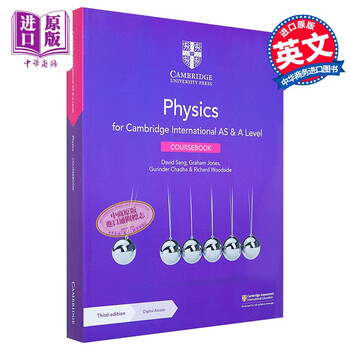
Cambridge International AS ALevel Physics Coursebook 正版剑桥国际AS ALevel考试物理教材带线上账号 英文原版¥557.0📱 去京东购买京东精选

需要一对一辅导?Need One-on-One Tutoring?
A-Level / GCSE / IB / KS2-KS3 全科辅导
16621398022 同微信
Visit aleveler.com
或截图后用「扫一扫 → 相册」选择本图